Thursday, 20 February 2020

Heritage uniforms FAQ

Guiding history and heritage are for every day, not just for Thinking Day! World Thinking Day (22 February) does tend to concentrate our activities in this area. We hope these questions and answers are helpful for planning events on a Thinking Day theme, and for discussion and activities throughout the Guiding year.

We hope they will help girls and Guiders to
  • research and plan Thinking Day events
  • identify/date historic uniform pieces or badges they may have at home
  • offer, accept, redirect, organize and use historic uniforms and printed materials for District heritage collections
  • enjoy finding out more about the history of Guiding in their Area and around the world
Q: Where do I start looking for information about Guiding history, world Guiding, the Founders, Thinking Day, historic uniforms, or changes of badges and program requirements over time?

A: When looking for Guiding information and program ideas, GGC National and Provincial websites and the online program platform are the first ports of call. Further suggestions of online and printed resources are below.

Q:  I have an old Guide uniform / belt / badges / hat. How do I work out exactly how old they are, which badges would have been earned during the same period, and which pieces should be worn together?

A: If you can find copies of old GGC store catalogues / price lists or POR, these are the best sources of information about historic uniforms at any given date and over time. Several things to remember:
  • especially in the earlier decades of Guiding, parts of older Canadian *and UK* Guiding uniforms were often worn years, decades or even generations after official changes came into effect. Leather belts seem to be a particularly popular and hardwearing hand-me-down item!
  • some uniform pieces may be retained unchanged from one 'uniform era' to the next, while the rest of the uniform changes substantially
  • uniform and badge/program changes do not always coincide, and uniform changes usually come into effect from one year to the next, while program changes may be phased in over several years, to allow girls to complete the program they started
  • online resources:
  • printed resources to look out for: 
    • previous versions of girl and leader handbooks / program books
    • POR
    • Canadian Guide magazine, published 1949-1966
    • Alive! the magazine for Canada's Girl Guides, published 1966-1970
    • back issues of Canadian Guider - (1932 - present, online from 2014
      • especially Heritage issue, Vol.65 no.1, January-February 1995
Q: I have an old Guide uniform / belt / badges / hat. Can I donate it to the SVI uniforms collection?

A: As of February 2020, SVI Districts have their own heritage uniform collections. There is no longer an Area collection, and further additions to uniform collections should be offered to Districts only.

Q: My SVI unit is planning an event and we would like to use heritage uniforms. What's available?

A: The District collections do not include examples of uniforms for every branch from every uniform era, so check your District's holdings early in your event planning. Districts may wish to augment their uniform holdings with copies of contemporary printed resources.

Q: I'm clearing out and have come across some outdated PORs and program books. They're no longer current and they take up space - should I just recycle them?

A: Printed material such as old Canadian Guider magazines, girl and Guider program books, and POR are great sources of historic uniform and badge information - which isn't all available online. Downsizing or decluttering? Clearing out Guiding storage cupboards? Check for vintage material that might be useful for your District's collection!

Q: I have some old Guide badges and pins. How do I find out how old they are, what they were called and how they were earned?

A: The Canadian Guiding Badges and Insignia Resource by Katherine Town and a research and editing group from the Archives of the GGC Ontario Council, covering 1910-2010, is a brilliant aid to identification and dating of old badges, but does not include program contents or badge requirements. The best sources for those are the contemporary program handbooks and POR.

Q: How do I find out more about the history of Guiding (events, properties, camps, members, photographs) in SVI?

A: SVI's archives are a good resource, but currently in storage and not accessible. Once they are permanently relocated, we hope to post more information about the archives and their contents here. The Lamplighter magazine records many Area events.

Q: I have archival material relevant to SVI's history. Can I donate it to the Area archives?

A: Not at the moment - the archives are in storage and the current SVI office does not have storage capacity for archive material. We'll update donation information as soon as possible. If you urgently need to dispose of the material, please do contact the archives team to discuss available options.

Q: How do I find out more about the history of Guiding in BC?

A: BC Guide House in North Vancouver has an archive of Provincial records; back issues of Pipeline magazine, online from 2016, are full of information; Look At Us Now! We Are 100! GGC BC Council, 2010, and its previous editions, starting with Now We Are 60, is a fascinating 'dictionary of Guiding in BC' rather than a narrative history.


More questions? Suggestions? Please email the SVI Archives team sviggcarchives [at] gmail dot com.

Monday, 13 January 2020

archive closure

As of January 2020, the archives for Southern Vancouver Island Area are in secure offsite storage following the sale of Guide House, and are not currently accessible for research by or on behalf of enquirers. We are unable to accept new donations to the archives. Arrangements for the permanent location of and future access to SVI's archives are under consideration, and will be posted on the Area website in due course.

The Area's loan collection of heritage uniforms has been divided for use at District level; please contact District Commissioners about borrowing from or donating further material to a District uniform collection.

For enquiries about the archives, please contact sviggcarchives [at] gmail.com.

Saturday, 23 November 2019

notice re new accessions

Owing to the ongoing process of selling Guide House, we are not currently accepting donations of archive material or heritage uniforms. Updates will be posted on the SVI website.

Wednesday, 3 July 2019

book covers

We are currently appraising some classic (mostly UK) Girl Guide fiction, survivors from the Hilda Leighton Memorial Library at Mason Street, and I thought I would share some of the fab covers:


Starting with some Brownie stories: Freda Collins' The Brownie Year
in which apparently children forage unsupervised for poisonous toadstools...
Well, supervised only by small fictional beings!


Betty and the Brownies by Ethel Talbot


frontispiece from Betty and the Brownies: 'Something escaped from Betty's pocket and went spinning down the room.' What do you think it was?


An added delight of looking through old books: the things that are left behind. This undated note reads, 'Sandra Wemyss knows how to use a telephone. (Mrs) D Wemyss.'
Do you think Sandra put it into the book for safekeeping, forgot it, and had to ask her mother to write it out again? Or did she use it as a bookmark after the telephone test was safely ticked off by Brown Owl on her Brownie record card?
Do Brownies still need to know how to use a telephone as part of the Brownie Programme?


Marigold Becomes a Brownie by Susan Jolly


Amanda and the Brownies by Verily Anderson


and moving up to Guides,
Dorothea Moore's Judy, Patrol Leader, first published 1934.
Here is some information about this cover of a later edition.


Here is the irresistibly exciting synopsis of Judy from the flyleaf.


The Rising of the Larks by Cris Johnson. Something tells me there is a very long-running pun about singing here.


The Hawthorn Patrol by Diana Pares.


Mrs Osborn Hann's Rosemary the Rebel.


The Ragtail Patrol by C. R Mansell


Another title by Dorothea Moore, Guide Gilly, Adventurer


The Guide's Honour by May Wynne


Frontispiece (the cover of this copy wasn't very interesting) of June the Girl Guide by Brenda Girvin.
I love the thick rag paper of most of these books, and the clear print. Reading a physical book, especially a nicely produced one like these, is a three-dimensional real life multi-sensory experience that just can't be replaced by reading on a screen. (Though e-versions would be very helpful for quick comparisons across multiple stories, key word searching etc.)


The Second Rucksack Book has my favourite cover purely because it wraps a panorama-format picture around back, spine and front.


Gillian of  the Guides by Winifred Darch. I am reliably informed, based on analysis of her uniform in the cover art rather than by reading the story, that Gillian is a Company Leader, which in the pre-Rangers era, when girls of modern Guide, Pathfinder and Ranger ages would all be Guides in the same Company, meant a senior Guide with considerable experience (possibly more Guiding years under her belt than some new Guiders!) and some Guider-like responsibility within the Company. Company Leader status is reflected by her three stripes (one for Second, two for Patrol Leader as per Judy above). And the gloves, perhaps.

Have you read this book? Are we correct?


Well-known Chalet School author Elinor M Brent-Dyer's Judy, the Guide. Not to be confused with Judy, Patrol Leader, above.


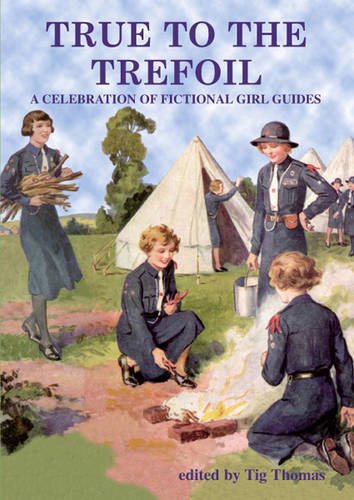
This is a very small selection (the ones we had with dustjackets both surviving and jolly) from a very well-populated 20th century genre of Brownie and Guide stories. If this is your sort of fiction, have you read True to the Trefoil: a celebration of fictional Girl Guides (Girls Gone By, 2010),  ed. Tig Thomas? More about this book here, and about the publishers here.

Most of these titles, and many similar ones, are still readily available second hand via, e.g. Bookfinder or ABEBooks. (Don't imagine that either is wholly independent of the ubiquitous Am-z-n, but sort of.)

Monday, 27 May 2019

Displays - Milne's Landing


A display titled 'Girl Guide Camp - Milne's Landing'.

The display as mounted shows facsimile prints of photos from the early years of Girl Guide camping at Milne's Landing campsite near Sooke. The dated items span 1924-1952. The photos demonstrate the contrast between the formality of full uniform at camp and a regimented structure of camp activities, and the fun, friendship and informal feeling of living (and cooking) outdoors. The tents have changed, dress is more relaxed, and we may seldom catch and gut our own fish from a tenting site, but the feeling of Guide camp is much the same!

There is no indication on this display of 
  • the sources or photographer credits for the photos (which are facsimile prints), and ownership/copyright in the originals
  • whether the original photos are in the SVI archive, and if so, their reference numbers
  • sources and credits for the captions
  • the person who created the display
  • the date and event for which the display was created
If we find more information as we continue to work on the archives, we'll update here. If you are able to share any of this information with us, please let us know!


Miss Mara, Mrs Leighton, Mrs Kinloch [at camp], 1924
Three Guide leaders in full uniform standing in line, with a large ?bell tent and tall evergreens in the background.


Miss Denny at a Guiders' Training Week, 1924


Miss Leighton at Camp at Saseenos [= Milne's Landing, Sooke], 1925.


The mode of transport to camp for Guides and baggage [: a motor truck with open high-sided bed]. All Guides were needed to push the truck up some of the hills on the Sooke Road.


A side view of the truck: 'GM Moody Transfer. Phone 2438'.


Sooke River Flats Camp: a row of bell tents. No date.


A notice about a 1952 camp at Milne's Landing, from an unidentified local newspaper: 'About 50 Girl Guides of Oak Bay East District Company are enjoying 10 days at camp at Milne's Landing. From early morning until dusk the camp is a scene of great activity. The guides to their own cooking, washing up and other chores. Nature study, swimming and hiking are all on the camp routine. Mrs Mary MacDougall is camp commandant. Visitors will be welcome at the camp this Saturday at 3pm.' Undated, annotated 1952.


Mrs Foster and Mrs Hall at Milne's Landing filleting fish, 1945.


Photo of a young woman in camp uniform, sitting on the ground beside a campfire, stirring a pot and minding a pan over the fire. No caption, date or identification.


 * Some of these photos show Guide camps at Milne's Landing nearly 100 years ago. What looks different to you from camping experiences you might have at Milne's Landing nowadays? What looks familiar? Think about tents, cooking equipment, clothing, activities, nature.

The photos and captions from this display have been filed with the Milne's Landing material in the archives.